Our mission at PCD Smiles is to bring smiles to hospitalized primary ciliary dyskinesia, no mater their age; through the gift of a cheer package. Currently serving only The United States and Canada.
Know of a hospitalized primary ciliary dyskinesia patient? Please visit our “Request a Cheer Package” link and fill out our secured form to submit them for a cheer package today!
The PCD Artist Project is a collaborative effort by artist to raise awareness for PCD & support the PCD Smiles cheer package program. Visit our exhibits today!
Written by PCD Smiles
on October 02, 2026.
Posted in Topic Thursday
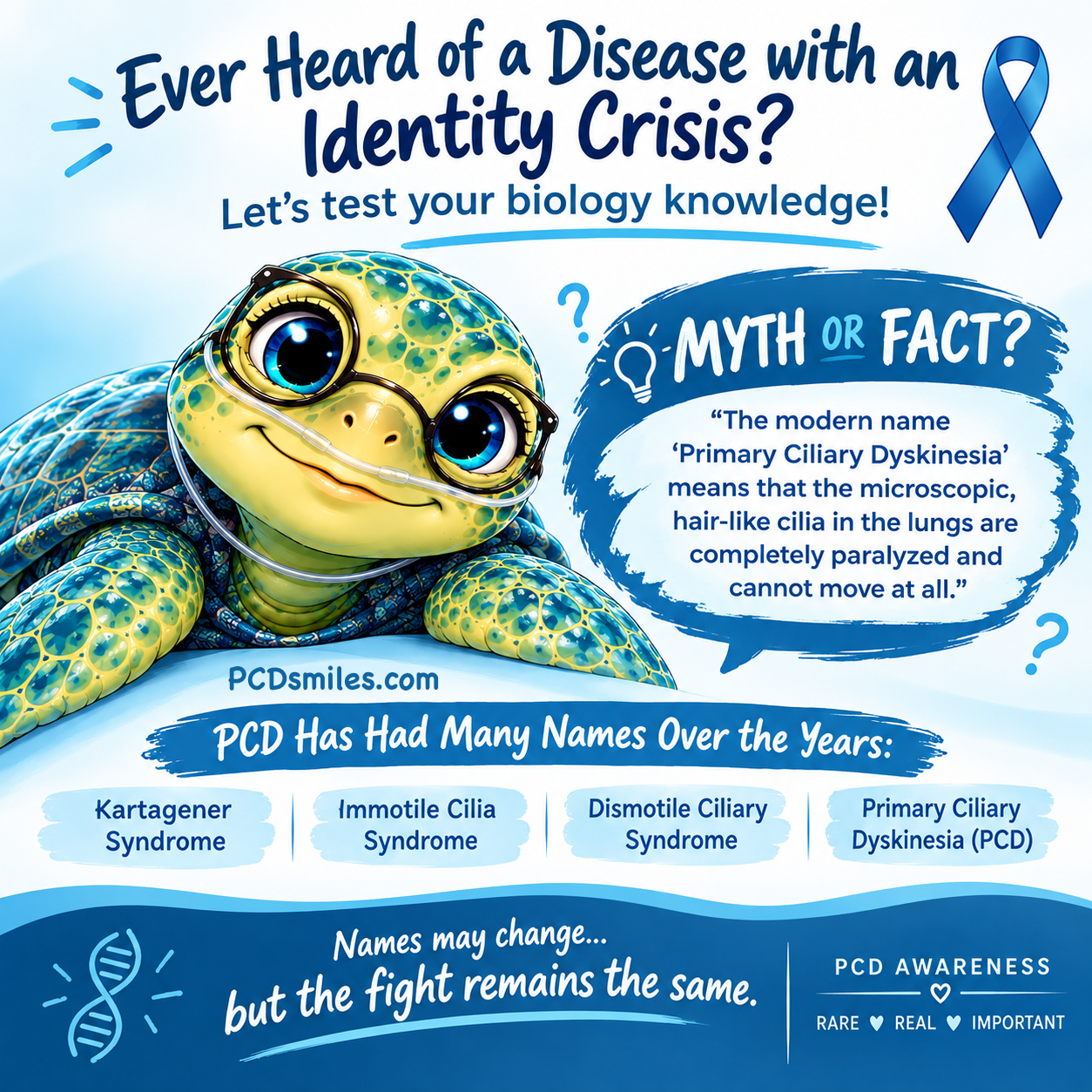
Let’s test your biology knowledge! MYTH OR FACT? "The modern name 'Primary Ciliary Dyskinesia' means that the microscopic, hair-like cilia in the lungs are completely paralyzed and cannot move at...
Written by PCD Smiles
on October 01, 2026.
Posted in Topic Thursday
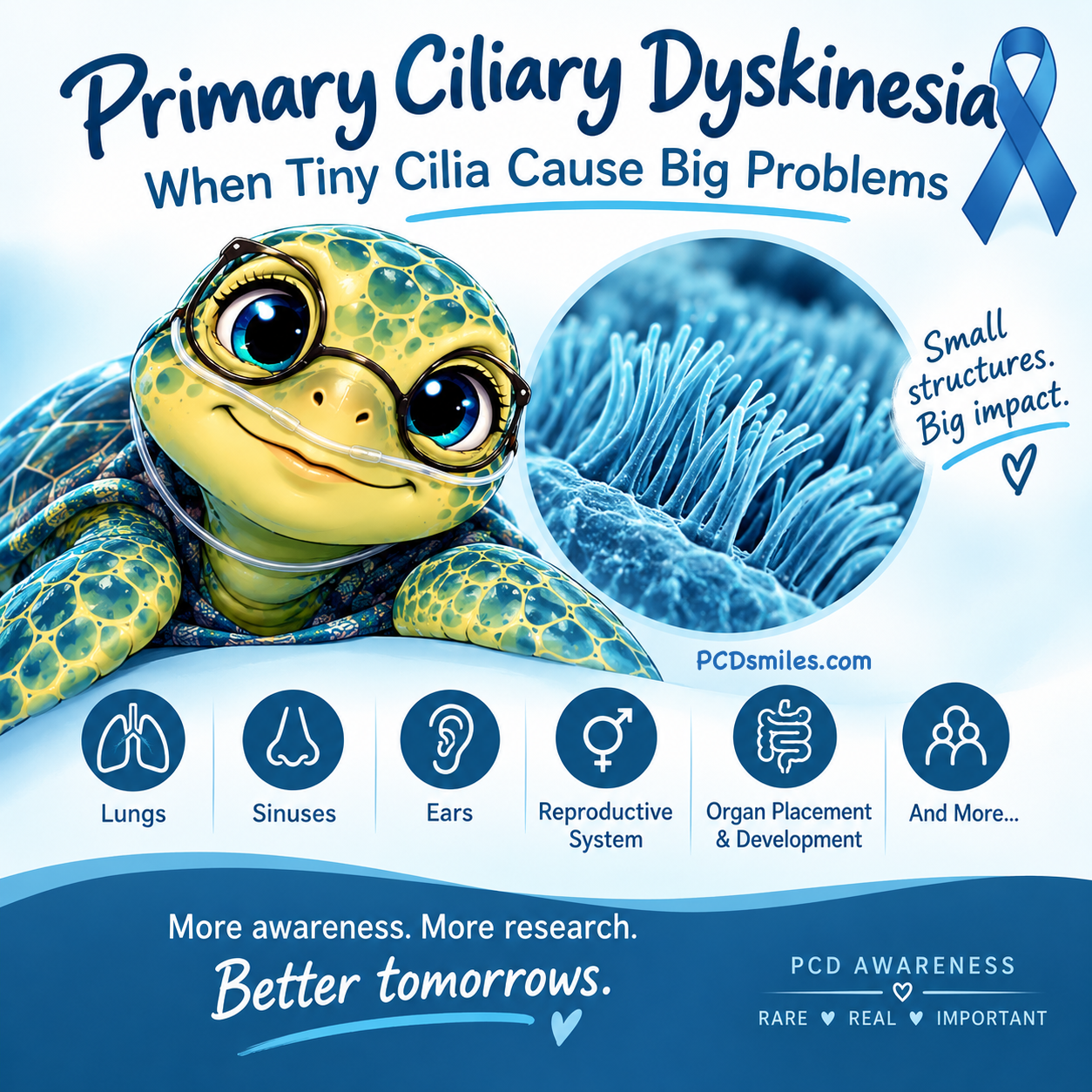
Imagine having millions of tiny cleaning crews inside your body—but those cleaning crews don't work properly. That's essentially what happens with Primary Ciliary Dyskinesia (PCD), a rare genetic...
Written by PCD Smiles
on May 09, 2024.
Posted in Topic Thursday
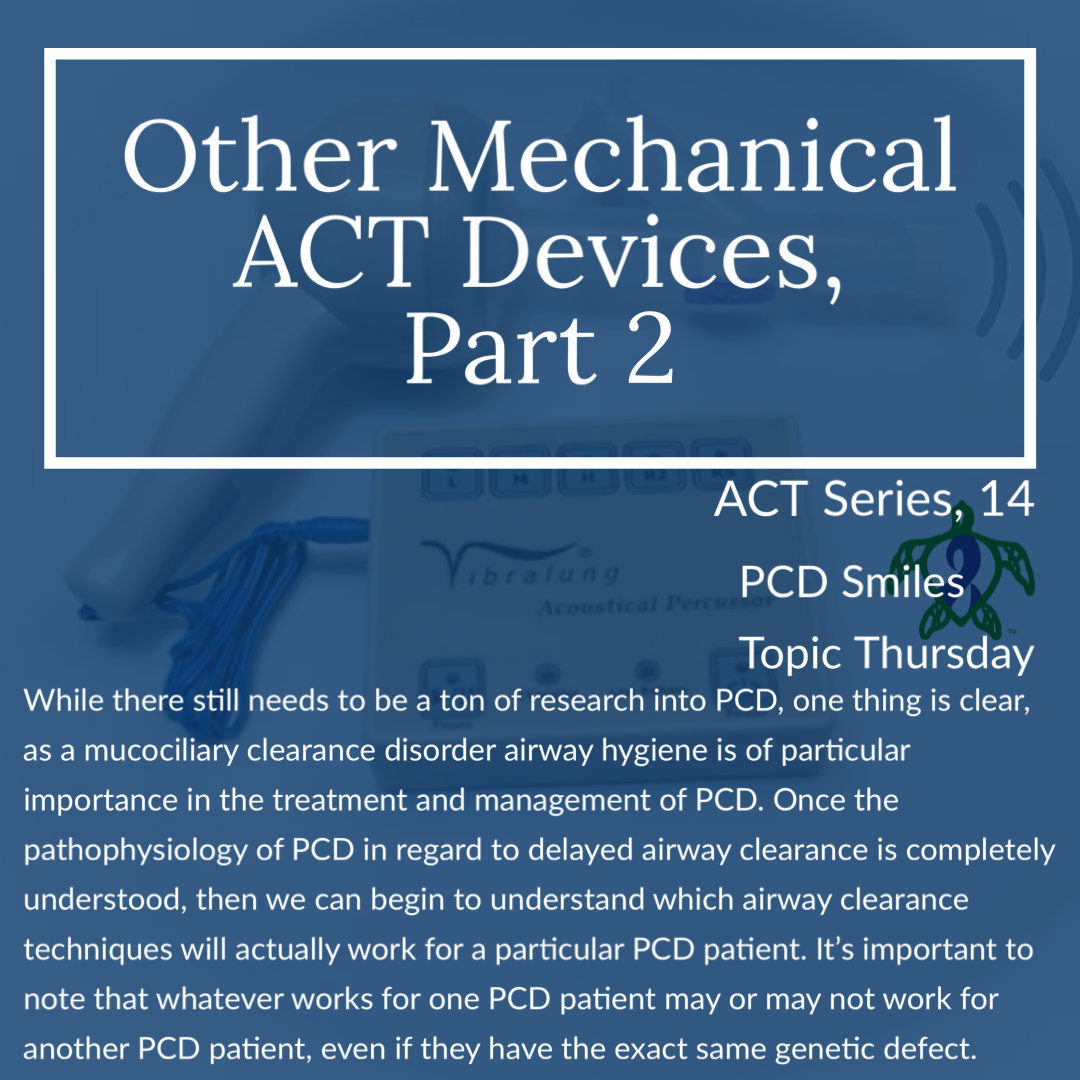
As the population who uses airway clearance techniques (ACTs) grows and ages with the advancement in pulmonary disease management, clinicians and patients alike are turning their attention to other...
Written by PCD Smiles
on April 30, 2024.
Posted in Topic Thursday
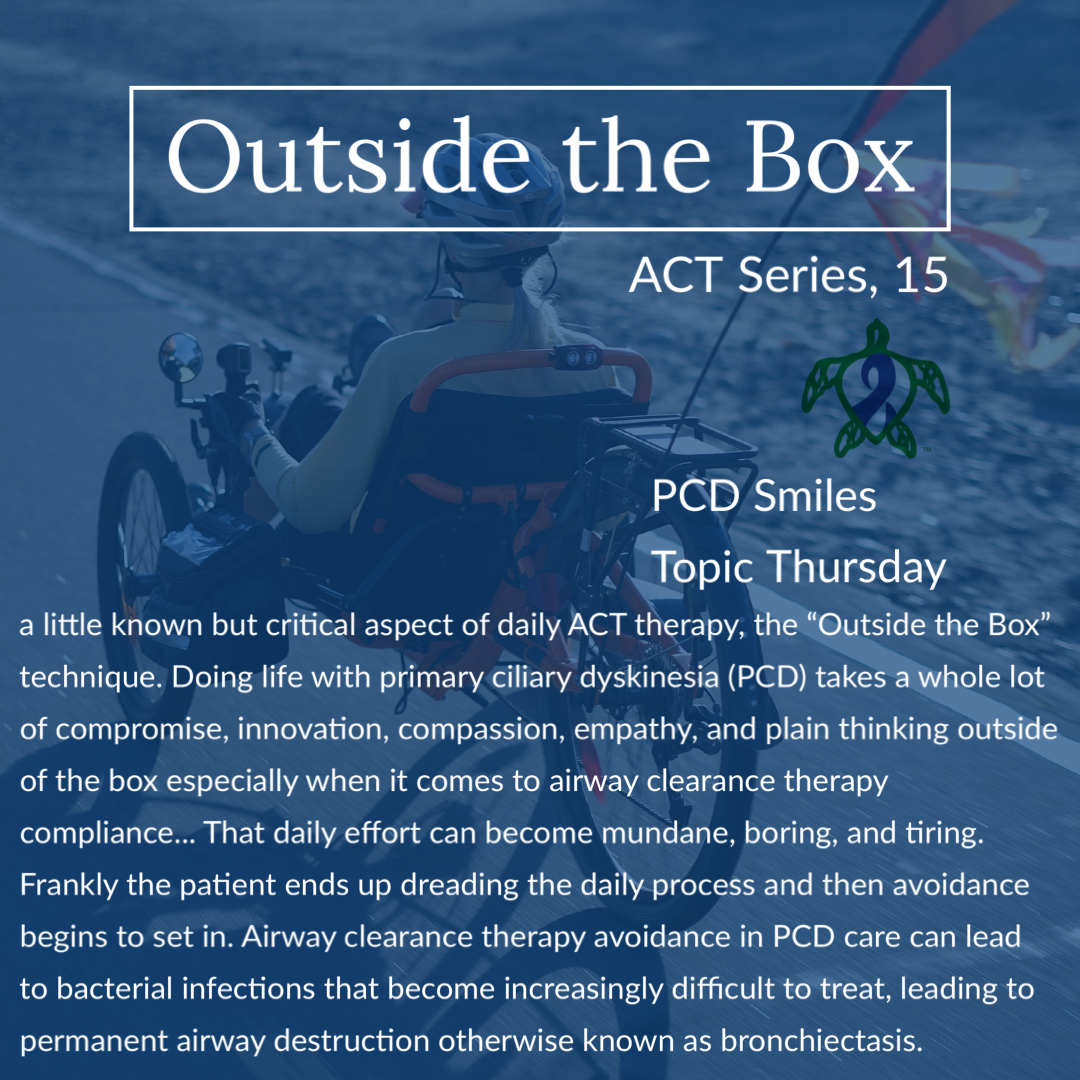
The last subject in our our sixteen part series on airway clearance techniques (ACTs) is a little known but critical aspect of daily ACT therapy, the “Outside the Box” technique. Doing life with...
MYTH OR FACT? "The modern name 'Primary Ciliary Dyskinesia' means that the microscopic, hair-like cilia in the lungs are completely paralyzed and cannot move at all." Think you know the answer? Continue reading to find out. For years, doctors and researchers couldn't quite agree on what to call
Imagine having millions of tiny cleaning crews inside your body—but those cleaning crews don't work properly. That's essentially what happens with Primary Ciliary Dyskinesia (PCD), a rare genetic condition that affects the tiny, hair-like structures called cilia.
PCD affects approximately 1 in 7,500 to 30,000 people. Because many of its symptoms can look like more common conditions, such as
As the population who uses airway clearance techniques (ACTs) grows and ages with the advancement in pulmonary disease management, clinicians and patients alike are turning their attention to other airway clearance techniques. Advances in disease management of cystic fibrosis (CF) is allowing the CF population to age and as such clinicians and patients are starting to see things in these patient populations that were not an issue even a decade ago. Like CF patients going on to have children, careers, and so on. This has brought about the apparent need for more airway clearance techniques tailored for patient situational needs. Even both the internet and social media have played a huge role in making the world closer. Airway clearance techniques from around the world are now getting daily exposure to patients groups and communities that have never heard of them before. This has sparked huge controversy on which is the right ACT for each disease. Clinicians and patients in one part of the world have never been exposed to an ACT that is offered in another country. Instead they rely on limited studies from disease patient population on a particular ACT device or method. While an ACT device or method may work for idiopathic pulmonary fibrosis, that same device or method may not work or may even be harmful to cystic fibrosis patients or even PCD patients. It is very dangerous and misleading to say “device A” doesn’t work as well as “device B” for all pulmonary diseases just because a limited study on non-purulent pulmonary disease shows “device A” is not helpful to non-purulent pulmonary disease patients. The same could be said for a different ACT device that is successful at helping CF patients should in fact be the best device for asthmatic with pneumonia patients. The techniques for airway clearance are tailored towards certain physiological factors of the airways. Like certain ACTs target or rather help augment the cilia, and other ACTs target airway ventilation to aid in airway clearance.
The last subject in our our sixteen part series on airway clearance techniques (ACTs) is a little known but critical aspect of daily ACT therapy, the “Outside the Box” technique. Doing life with primary ciliary dyskinesia (PCD) takes a whole lot of compromise, innovation, compassion, empathy, and plain thinking outside of the box especially when it comes to airway clearance therapy compliance. When the body’s natural filter for germs, bacteria, and debris is compromised that leaves the PCD patient to have to manually clear and remove those secretions that can be removed on a daily basis. That daily effort can become mundane, boring, and tiring. Frankly the patient ends up dreading the daily process and then avoidance begins to set in. Airway clearance therapy avoidance in PCD care can lead to bacterial infections that become increasingly difficult to treat, leading to permanent airway destruction otherwise known as bronchiectasis. Bronchiectasis (BE) is a clinical consequence of having PCD, and by adulthood BE is almost universal among adult PCD patients. The goal of airway clearance therapy in PCD care is to get the patient to cough and to delay the onset of BE for as long as possible.
As we near the end of our airway clearance technique (ACT) series there are a few other mechanical ACT device outliers left to discuss. In a social media age the resurgence of holistic practices have come full circle once again, as has the age of invention. Then add in recent awareness campaigns for rare diseases and there is a ton of focus helping those who have no help or treatments. The awareness campaigns for diseases like primary ciliary dyskinesia (PCD) have succeeded in bringing together not only the patient population, but clinicians and researchers a like. While there still needs to be a ton of research into PCD, one thing is clear, as a mucociliary clearance disorder airway hygiene is of particular importance in the treatment and management of PCD. Once the pathophysiology of PCD in regard to delayed airway clearance is completely understood, then we can begin to understand which airway clearance techniques will actually work for a particular PCD patient. It’s important to note that whatever works for one PCD patient may or may not work for another PCD patient, even if they have the exact same genetic defect. In “Part 2” we will look at the Lung Flute, the Vibralung Acoustical Percussor, the Revitive Aerosure, & cough assist devices.