

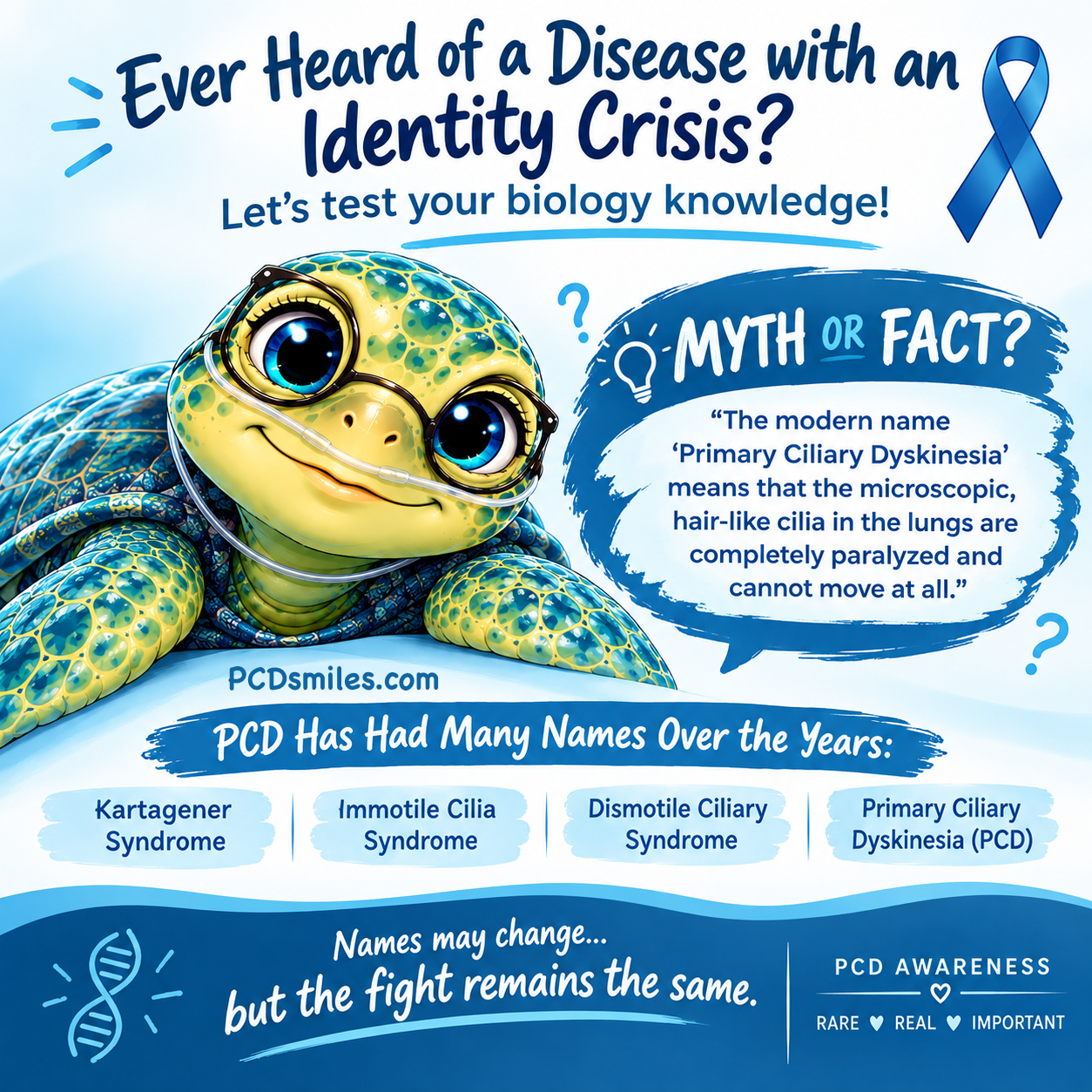
Let’s test your biology knowledge!
MYTH OR FACT?
"The modern name 'Primary Ciliary Dyskinesia' means that the microscopic, hair-like cilia in the lungs are completely paralyzed and cannot move at all."
Think you know the answer? Continue reading to find out.
For years, doctors and researchers couldn't quite agree on what to call
PCD. Depending on when you were diagnosed, you might have heard it called Kartagener syndrome, immotile cilia syndrome, or even dismotile ciliary syndrome.
So, why the name confusion? It all comes down to science catching up with history!
- The "Immotile" Mix-up: In the 1970s, scientists thought the microscopic, hair-like cilia in the airways were completely frozen. They called it "immotile cilia syndrome".
- The "Dismotile" Pivot: As technology improved, doctors realized some cilia did move, but their motion was completely weak or abnormal. They introduced the term "dismotile ciliary syndrome" to bridge the gap.
- The Modern Name (PCD): By 1983, the medical community united under Primary Ciliary Dyskinesia. "Dyskinesia" means abnormal, uncoordinated movement. This perfectly describes how the cilia beat chaotically and ineffectively, rather than just being still.
- What about Kartagener’s? Named after the doctor who discovered it, Kartagener syndrome is a specific subset of PCD. It refers to PCD patients who also have situs inversus—where their internal organs (like the heart and liver) are flipped to the opposite side of the body! Interestingly, this only happens to about 50% of the PCD community.
Fast Forward: Is Another Name Change Coming?
Science never stops moving! With an explosion of research over the last two decades, scientists have already found over 50 different genetic mutations that cause PCD. Because the disease looks and behaves differently depending on a person's exact genetic profile, experts suggest the name will likely evolve again. In the future, we may shift toward highly specific, gene-based naming systems to mirror the precision medicine being developed to treat it.
THE ANSWER:
It’s a MYTH! That misconception is exactly why the medical community threw out the old name "immotile cilia syndrome". Advanced technology proved that the cilia do move—they just beat in a completely chaotic, stiff, or uncoordinated way ("dyskinesia"). Because they can't sweep together effectively, they can't clear mucus from the lungs.
The Bottom Line:
Names change, but the fight remains the same. Whether it's called PCD, Kartagener's, immotile ciliary syndrome, or dismotile ciliary syndrome, this rare genetic condition causes chronic lung infections, hearing issues, fertility challenges, and more. Clearing up the names helps patients get diagnosed faster and find the right support.
Be sure to join us tomorrow for another conversation about primary ciliary dyskinesia.
Join our Facebook group Turtle Talk Café today.
We have several ways that you can donate to PCD Smiles;
- Visit Smile E. Turtle's Amazon Wishlist
- For more information on how you can donate, please visit our "Donation" page to check out our "Do & Don't policies.
- Or sponsor a PCD Smiles cheer package today!
- To shop for your “Official” turtle care ribbon gear today, visit PCD Style
Thank you for your consideration!
Medical Disclaimer
This article is intended for general educational and informational purposes only and is not a substitute for professional medical advice, diagnosis, or treatment. Infection risks and appropriate prevention strategies can vary considerably between people with PCD based on their lung health, respiratory cultures, treatments, age, and other medical conditions.
Cleaning and disinfection recommendations for respiratory equipment can also vary by device and manufacturer. Always follow the instructions provided by your healthcare team and equipment manufacturer.
Do not start, stop, or change medications, airway-clearance treatments, infection-control practices, or other aspects of your medical care based solely on this article. If you have PCD and are concerned about an infection, worsening respiratory symptoms, or possible exposure to a pathogen, contact your PCD or respiratory healthcare team for individualized guidance.
If you are experiencing severe or rapidly worsening breathing difficulties or another medical emergency, seek urgent medical attention.